Categories
Traditional Style

Kiritsuke Knife

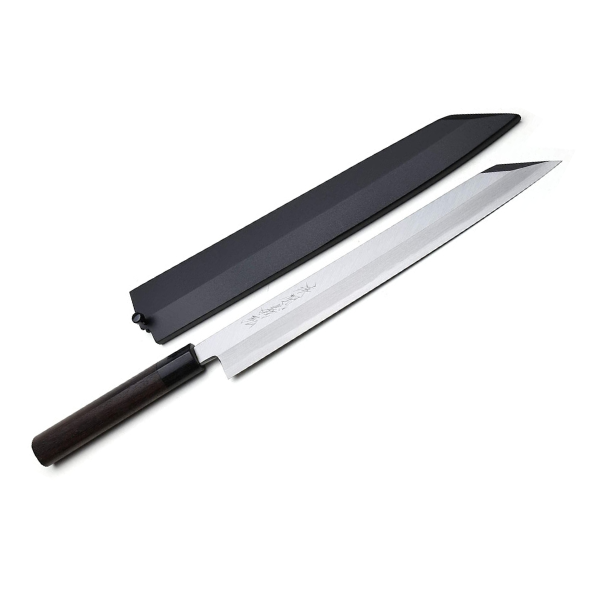
The Kiritsuke is one of the few traditionally multi-purpose Japanese-style knives, and is a hybrid between the Yanagiba (raw fish slicer for sashimi) and the Usuba (Japanese-style vegetable knife). This versatile knife features a long blade like a Yanagiba and a straight cutting edge like an Usuba, resulting in a hybrid design with dual personalities; it can be used like an Usuba for cutting vegetables, or like a Yanagiba to easily slice raw fish. Its long and flat blade, straight edge and angled ‘reverse tanto’ or ‘clip point’ tip lends the Kiritsuke its signature sword shape.

Like most traditional Japanese knives, the Kiritsuke is a single bevel knife, meaning that only one side of the blade is ground to form a razor-sharp edge. A double bevel Kiritsuke usually refers to a variation of the Gyuto knife with a Kiristuke-style edge, and is often labeled as a Kiristuke Gyuto or a K-tip Gyuto.

Because the Kiritsuke is essentially a combination of both Usuba and Yanagiba knives which are developed for very different tasks, considerable skills are required to master the use of this unique Kiritsuke design with its considerable length, height, weight and its single-bevel edge. For this reason, the single bevel Kiritsuke is traditionally reserved for use by only executive chefs in Japanese kitchens, and is regarded as a symbol of status, expertise and seniority.

What does Kiritsuke mean?

Literally translated, ‘Kiritsuke’ in Japanese means to ‘slit open’. True to its name, the long and tall blade combined with its straight, sharp edge and angled ‘reverse tanto’ tip makes the Kiritsuke an all-rounder for preparing Japanese cuisine, such as to slit and finely slice vegetables, or prepare glossy and smooth slices of raw fish for sashimi.

What is a Kiritsuke knife best for?

The Kiritsuke is best for cutting vegetables and slicing fish, just like the Usuba and the Yanagiba. It can also be used to thinly slice or portion boneless proteins, such as chicken. However, it is not a substitute for a Chef’s Knife or the Gyuto, and should not be treated like one.

As one of the few multipurpose traditional Japanese knives, the sword shape of the Kiritsuke features a straighter edge than a Yanagiba for cutting vegetables, and a longer blade than an Usuba to allow the knife to slice fish with ease. The long, flat blade is great for chopping large vegetables, however the straight edge doesn’t allow for the rock-chopping technique that is favored by many Western cooks. Rather, the Kiritsuke requires a pull-cut motion for slicing raw fish and a push-cut motion for slicing vegetables.

Kiritsuke knife characteristics

Size

The single bevel Kiritsuke knife is a versatile knife that can be used to perform tasks usually done by the Yanagiba and Usuba, namely for slicing fish and cutting thin slices of vegetables. The Kiritsuke is available in a variety of blade lengths, ranging from 240mm to 330mm. The larger 270mm size is our recommendation, as it is long enough to perform the long drawing cuts when slicing fish, as is usually done with the Yanagiba.

The Kiritsuke is traditionally taller than a Yanagiba, so if you find a knife with a long and narrow blade and an angled tip, it is most probably not the standard Kiritsuke but the Kensaki Yanagiba, which is also called the Kiritsuke Yanagiba and features the distinct ‘reverse tanto’ tip on a Yanagiba blade.

Shape

The Kiritsuke has a sword-like shape with its long and flat blade, straight edge and angled ‘reverse tanto’ or ‘clip point’ tip. The edge of the blade is straighter than a Yanagiba, and the length of the blade is longer than an Usuba. If you’re familiar with the Kiritsuke Yanagiba (also called the Kensaki Yanagiba), the traditional single bevel Kiritsuke has a similar profile, but is a wider version of the Kiritsuke Yanagiba with more height and a flatter edge.

The heel section of the Kiritsuke is virtually flat, and can be used just like an Usuba. The flat profile of the Kiritsuke works best with a push-cutting technique, and is great for chopping thin slices of vegetables. The angled tip is useful for precise cutting, and the long length of the blade allows you to easily slice through raw fish and proteins in one swift pull-cut, which helps to preserve the texture of the food and minimize damage to the cells which can discolor or change the taste of the food.

Edge

The Kiritsuke knife has a single bevel edge, which means that it is only ground on one side of the blade to achieve an extremely sharp cutting edge. The other side of the blade is slightly concave, which gives the Kiritsuke an unique non-stick property that allows the perfectly thin slices to be removed easily without sticking to the blade. When using a single bevel knife, only the cutting edge of the blade lightly touches the food being cut, making it ideal for preserving the natural freshness, flavor and texture of the food.

However, single bevel knives require a learning process to master cutting straight with this “handed” knife. Right-handed Kiritsukes tend to pull to the left while cutting, whereas left-handed Kiritsukes tend to pull to the right. It should also be noted that most single bevel knives are created for right-handed use, so if you are left-handed, be sure to look for a left-handed Kiritsuke knife.

Handle

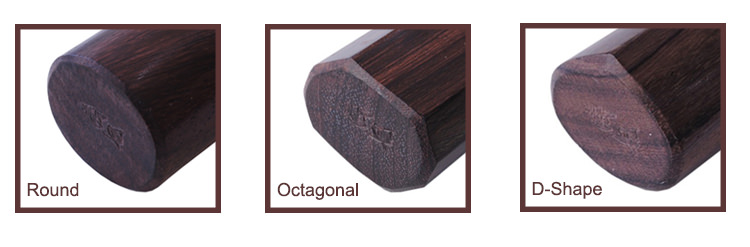
Kiritsuke knife handles can be categorized into two categories: the traditional Japanese ‘Wa-Handle’, or a Western-style handle. Most Kiritsuke knives feature a wooden Wa-Handle.

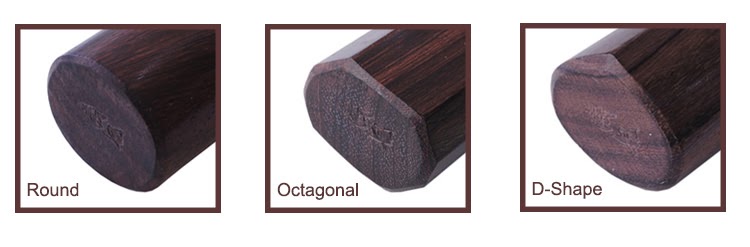
The most common wa-handle shapes are the D-shape, oval, or octagonal. While some prefer the ergonomic grip of a D-shaped or octagonal handle, the choice of the handle comes down to personal preference.

How are Kiritsuke knives made?

To understand how exactly the Kiritsuke knives are made and to decode the common phrases that are found in descriptions of Kiritsuke knives, it’s necessary to look at how traditional Japanese knives are forged and what materials are used.

There are two basic categories of Japanese knives – honyaki and kasumi – which are defined by the materials and methods used in their forging.

Honyaki (“true-forged”) knives are manually forged by hand following traditional Japanese blacksmithing techniques, and are created entirely out of one single material: high-carbon steel (hagane). The hagane is generally a type of White Steel (Shirogami) or Blue Steel (Aogami), and this style of knife blade is also called a mono steel blade.

The method of creating a Honyaki knife is similar to how Katanas (Japanese traditional swords) were made in the past. Forging a Yanagiba knife is a lengthy and difficult manual process that begins with a single high-carbon steel blank, and involves multiple rounds of heat treatment, steel hammering, kilning, polishing and sharpening – all done manually by the hands of skilled Japanese blacksmiths in traditional knife-making cities such as Sakai (in Osaka), Seki (in Gifu), and Echizen (in Fukui).

Because Honyaki knives are forged from high-carbon steel, its blade is extremely hard and can be sharpened to incredibly thin and sharp edges, which will remain sharp for a long time. However, they are challenging to resharpen and prone to chipping, cracking or breaking if used improperly. Due to the small-scale production and the highly-skilled artisan nature of the blacksmiths, Honyaki knives are more expensive, and recommended for experienced and professional chefs who can maintain them.

On the other hand, Kasumi (“mist”) knives are made by joining together a piece of soft iron (jigane) with a piece of high-carbon steel (hagane) to create a laminated blade. After forging, hammering and shaping, the carbon steel (hagane) becomes the cutting edge and backside of the blade, while the soft iron (jigane) forms the body and spine of the blade. The hazy appearance of the soft iron body of the blade in contrast with the glossy carbon steel gives kasumi its signature ‘mist’ appearance, as referenced by its name. Thanks to the added soft iron, Kasumi blades have reduced brittleness overall, and are cheaper and easier to sharpen than honyaki knives.

In relation to kasumi knives, Hon Kasumi or Hongasumi knives are also commonly found, and refers to a higher grade of kasumi knives. Although hongasumi knives are made in the same way as kasumi knives, they are often made from higher quality materials and involve extra attention and steps in its forging, tempering, polishing and finishing processes.

For more information on how Japanese knives are made and the types of steels used, check out our blog on how Japanese knives are made. (link coming soon).

What are common types of Kiritsuke knives?

Kiritsuke knife variants are often a source of confusion, as some retailers tend to ambiguously label different variants as simply ‘Kiritsuke’, when in fact they are a Kensaki Yanagiba (also called Kiritsuke Yanagiba), or a Kiritsuke Gyuto (also called Double Bevel Kiritsuke or K-tip Gyuto). These are the most common types of Kiritsuke knife variants.

Kiritsuke Yanagiba – also called Kensaki Yanagiba

The Kiritsuke Yanagiba is a variant of the Yanagiba knife, and is also called the Kensaki Yanagiba. The Kensaki Yanagiba also features a single-bevel edge and the distinct ‘reverse tanto’ tip, however it has a narrower blade than the Kiritsuke and is specifically designed for slicing raw fish for dishes such as sashimi or nigiri sushi. The blade length ranges from 240mm to 330mm.

Kiritsuke Gyuto – also called Double Bevel Kiritsuke or K-tip Gyuto

The Kiritsuke Gyuto is a variant of the Japanese chef’s knife, the Gyuto, and is often referred to as the Double Bevel Kiritsuke due to the blade being ground on both sides, just like a typical Western-style knife. The Kiritsuke Gyuto is recommended for those who are attracted to the style of the Kiritsuke and its angled ‘reverse tanto’ tip, but are looking for more versatility in terms of use. The double bevel grind also helps users to avoid the learning curve that is associated with single bevel knives.

The Kiritsuke Gyuto tends to have less of a blade curve (or ‘belly’) than the typical Gyuto, making them less ideal for rock-chopping but better suited for push-cutting, or tap-chopping. Kiritsuke Gyuto knives are typically available in blade lengths between 240mm to 330mm, with the 270mm size being a popular alternative to the Gyuto.

If you’re trying to decide between the Kiritsuke and the Gyuto as your next general all-rounder knife, here’s a helpful quick video that highlights the differences between the Kiritsuke and the Gyuto based on their cutting techniques, versatility, ease of use and more:

What are popular Kiritsuke knife brands?

Kiritsuke knives originated from Japan, and to this day, there are traditional Japanese blacksmiths in famous knife-making cities such as Sakai (in Osaka), Seki (in Gifu) and Echizen (in Fukui) who still forge Kiritsuke knives manually by hand. Some popular Kiritsuke knife brands include:

  • Gekko
  • Shun
  • Masamoto
  • Yoshihiro
  • Suisin
  • Tojiro

How to choose a Kiritsuke knife

If you’ve got your heart set on buying a Kiritsuke knife, it can seem difficult to figure out which particular Kiritsuke knife will be perfect for you, especially if you haven’t had the chance to try out a few models in person to get a feel for which size and weight of the Kiritsuke feels the most balanced and comfortable in your hand.

You can see our best recommendations here, but here are some factors to first consider that will help you to choose your Yanagiba knife:

  • Types of steel
  • Handle styles
  • Ideal size
  • Your budget

Which steel should I choose for my Kiritsuke knife?

Generally speaking, you have a choice between carbon steel and stainless steel when buying a Yanagiba knife. The type of steel you choose will determine the knife’s edge retention, how easy it is to sharpen, level of resistance to corrosion and rusting, and its overall durability. You can first evaluate which of these factors is the most important for you, and narrow it down from there.

Carbon-steel blades are easier to sharpen and maintain their sharp edges for longer, but require more maintenance as it is prone to rust and corrosion. Over time, a dark patina will form on a carbon-steel knife, but some people like the look of a patina. Popular options include White Steel (shirogami) and Blue Steel (aogami).

Stainless steel blades are generally less expensive, tougher, less likely to chip and more corrosion-resistant, however are harder to sharpen and tend to dull quicker. Popular options include VG-10, SG-2, AUS-10, Gingami #3 and Swedish Stainless Steel.

What is the best handle for a Kiritsuke knife?

The handle of your Kiritsuke knife will determine how balanced the knife feels in your hand and how comfortable it feels to use.

Consider your usual grip on a knife. If you mostly hold the knife by the handle, a shaped or tapered Western-style handle will feel more comfortable and familiar to you.

If you hold the knife by using a pinch grip, a traditional Japanese-style handle (also called a ‘wa-handle’) will feel great in your hand. The most common wa-handle shapes are the D-shape, oval, or octagonal. While some prefer the ergonomic grip of a D-shaped or octagonal handle, it all comes down to personal preference.

Most traditional Kiritsuke knives have a Japanese-style handle made of wood.
How do I take care of a Kiritsuke knife?

When purchasing a Kiritsuke knife, it’s important to think about how you will care for and maintain your Kiritsuke knife. Kiritsuke knives should only be sharpened with water whetstones, and always be hand washed and dried after use to prevent rusting and corrosion.

There are lots of detailed videos on YouTube which show you step-by-step how to sharpen your Kiritsuke knife. Otherwise, some Kiritsuke knife sellers offer a paid sharpening service by trained Japanese knife sharpeners, which can be a wise option to preserve the sharpness of the single bevel blade.

How much should I spend on a Kiritsuke knife?

There are countless options for a Kiritsuke knife, with many Kiritsuke Gyutos available at entry-level prices to traditionally hand-forged single bevel Kiritsuke knives for over $500. Setting your own spending limit will help narrow down your hunt for the best value Kiritsuke knife.

Because of the steep learning curve related to the single bevel Kiritsuke knife, it is harder to find entry-level priced choices for a single bevel Kiritsuke knife. If you’re looking to try out the Kiritsuke style but feel more comfortable with double bevel knives, the Kiritsuke Gyuto is a nice compromise.

Our favorite entry-level Kiritsuke knives include the Dalstrong Kiritsuke Chef Knife from the Shogun Series with Japanese AUS-10V Super Steel and the Findking Prestige Series 9-Inch Kiritsuke Knife, both of which are good value for the types of steel used. If you’re looking to invest a little more, the Shun Dual Core CG0017 8-Inch Kiritsuke Knife comes highly recommended as the winner of the 2014 Knife of the Year at The Blade Show held in Atlanta, Georgia. Winners are judged on a wide range of criteria such as design, innovation, function and craftsmanship, and selected by the vote of industry professionals, so it’s sure to be a lasting investment piece.

Frequently Asked Questions

Should I buy a Kiritsuke knife?

Traditionally, single bevel Kiritsuke knives are regarded as ‘master chef’ knives and reserved for only the executive chef in Japanese kitchens, as they require a great deal of knife control and skills to master its unique design. If you already have some experience with single bevel knives and are searching for a versatile knife that can be used for both vegetables and fish, the single bevel Kiritsuke knife will meet your needs.

However, as the Kiritsuke is a hybrid knife, some of the exceptional slicing abilities of the Yanagiba and the Usuba are compromised when blended together into the Kiritsuke. If you’re serious about getting the best slices of sashimi or expertly thin slices of vegetables, the Yanagiba, Usuba and Nakiri are our best alternative recommendations. If you wish to own a hybrid of the Yanagiba and Usuba but are hesitant because of the significant learning curve of a single bevel knife, a Kiritsuke Gyuto is a nice compromise.

How do you sharpen a Kiritsuke knife?

Sharpening a Kiritsuke knife should only be done with water whetstones. To sharpen a single bevel knife, follow the bevel and begin at the tip of the knife, followed by the rest of the cutting edge from the tip of the knife to the heel of the blade.

Here’s a quick video on how to sharpen a single bevel knife, which will work on a Kiritsuke as well:

For more information, visit our page on how to sharpen Japanese knives. (link coming soon)

Who makes the best Kiritsuke knife?

At Japanese Knives Guide, we believe that the best Kiritsuke knife is one that fits your budget, grip style, expected steel type and your chosen size of the blade. Of course, this will differ from one person to the next, so our ‘best’ recommendations are always those which present great value for money for a relatively new Japanese knife enthusiast.

If you’re new to the world of Japanese knives, our foolproof recommendation is this: before jumping at the first chance to own an expensive, high-end Kiritsuke knife, be realistic about the learning curve that is involved for using and caring for Japanese knives.

While the exquisite hand-crafted Kiritsuke knives with the hardest and most expensive steel may catch your attention, it’ll become quite a different story when you realize that the hefty price tag also comes with the need to re-learn the basics of cutting straight with a single bevel blade, as well as the high-maintenance care routine that is required for the finest Japanese knives. Rather than dish out a few hundred dollars from the beginning without much experience, why not try your hand with a budget-friendly Kiritsuke knife to see if it’s the right fit for you?

Amazon is an accessible and reputable retailer with plenty of Kiritsuke knife options, a transparent customer review section and an incredibly generous returns policy, which makes it the perfect hassle-free and worry-free option for first-time owners of a Kiritsuke knife. There are many specialized smaller retailers out there, but you’ll be hard pressed to find one that can provide as much peace of mind with the same level of service and returns policy as Amazon.

For those who have never used a Kiritsuke knife before, our recommended entry-level Kiritsuke knives include the Dalstrong Kiritsuke Chef Knife from the Shogun Series with Japanese AUS-10V Super Steel and the Findking Prestige Series 9-Inch Kiritsuke Knife, both of which are good value for the types of steel used.

If you’re looking to invest a little more, the Shun Dual Core CG0017 8-Inch Kiritsuke Knife comes highly recommended as the winner of the 2014 Knife of the Year at The Blade Show held in Atlanta, Georgia. Winners are judged on a wide range of criteria such as design, innovation, function and craftsmanship and selected by votes from industry professionals, so it’s sure to be a lasting investment piece.

Where to buy a Kiritsuke knife

Amazon is our retailer of choice for purchasing a Kiritsuke knife, as they’re easily accessible, have a standing reputation for great customer service and a transparent customer review section and offer a variety of options for Kiritsuke knives

While there are many smaller retailers who specialize in just Japanese knives, Amazon offers a very generous returns policy, so you can make your purchase hassle-free with further peace of mind.

Some of our favorite Kiritsuke knives include:

Categories
Western Style

Petty (Paring/Utility) Knife

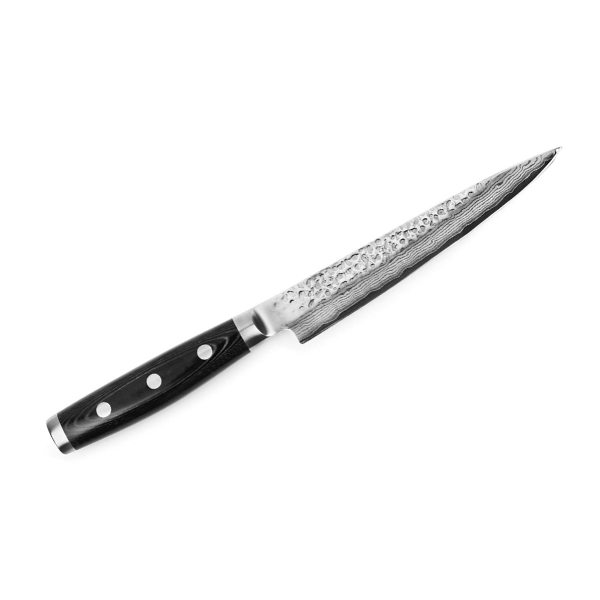
The Petty knife, also known as the Japanese paring knife or the Japanese utility knife, is a versatile multi-purpose knife that is typically larger than a western paring knife, but smaller than a western chef’s knife or the Japanese chef’s knife, the Gyuto.

Petty knives are considered to be a smaller version of the Gyuto chef’s knife and are similarly used as an all-rounder knife to peel, slice, dice, mince, peel and trim a variety of smaller fruits, vegetables, herbs, garnishes and proteins.

Particularly loved by line cooks in professional kitchens for its compact size and versatility, the Petty knife is also highly recommended for those who:

  • have a smaller workspace
  • want a smaller knife for quick use when a full-sized Gyuto or chef’s knife would be unwieldy (to cut a lime, for example), or
  • have smaller hands and want a lighter alternative to the Gyuto

What does Petty mean?

The name of the Petty knife is said to be derived from the word ‘petit’, meaning ‘small’ or ‘little’ in French. The Petty knife is seen as a smaller version of the Gyuto, the Japanese chef’s knife. The Petty knife is also sometimes referred to as a Japanese paring knife or a Japanese utility knife.

What is a Petty knife best for?

The Petty knife is best for smaller tasks such as slicing or dicing vegetables, fruits and herbs; light butchery work; and for delicate tasks such as making precision cuts.

In particular, smaller petty knives with blades of 80-90mm are useful for off-board cutting or peeling (‘paring’) fruits and vegetables in the hand, or for fine precise work on a chopping board such as brunoise cuts and slicing herbs and garnishes.
The larger sized Petty knives with blades of 120mm to 150mm are considered to be a smaller alternative of the Gyuto chef’s knife, and are similarly used for a wide variety of tasks including slicing and dicing vegetables or fruits, trimming meat, filleting small fish, and other light butchery work. Petty knives of this size are often used by chefs and line cooks during service as the compact size takes up minimal space on the board but functions as a versatile workhorse.

Petty knife characteristics

Size

The Petty knife is generally larger than a western paring knife but smaller than a western chef’s knife or the Japanese chef’s knife, the Gyuto. Petty knives are available in a wide variety of blade lengths ranging from 80mm to 180mm.

The most common blade lengths for a Petty knife are between 80-90mm, or 120-150mm. A 80-90mm Petty knife is ideal for peeling smaller fruits and vegetables in the hand or for fine and delicate tip work on the chopping board. A 120mm or 150mm Petty knife is best recommended as an alternative option to the Gyuto for those with small hands, or for those who have limited workspace in their kitchen.

Shape

The Petty knife shares a similar profile to the Gyuto Japanese chef’s knife and is typically tall and flat at the heel with a slight curve in the front edge of the blade, leading to its pointed tip. The relatively flat heel of the blade makes it well-suited for a variety of chopping styles such as thrust-cutting, while the slight belly towards the tip of the blade allows for easy rock-cutting. The pointed tip of the Petty knife also helps to achieve clean precision cuts.

Edge

The Petty knife typically features a double bevel blade with a razor-sharp edge, as Japanese double bevel knives are ground at a much more acute angle of 10-15 degrees than those of a western paring knife or a western chef’s knife.

Handle

Petty knife handles can be categorized into two categories: the traditional Japanese ‘Wa-Handle’, or a Western-style handle.

The most common wa-handle shapes are the D-shape, oval, or octagonal. While some prefer the ergonomic grip of a D-shaped or octagonal handle, the choice of the handle comes down to personal preference.

How are Petty knives made?

The history of the Japanese Petty knife dates back to the post-Meiji era after Japan opened its borders and began to trade with other countries. The western world started to influence everyday life in Japan including the Japanese diet, and eventually also influenced Japanese kitchens and their utensils. It is said that the Japanese adapted the Petty from the western utility knife, which originally evolved from the French office knife ‘couteau d’office’. This may be the reason that the Petty knife got its name, as the word ‘Petty’ comes from the French word ‘petite’, meaning ‘little’ or ‘small’.

To this day, traditional blacksmiths in Japan still forge Petty knives manually by hand, although many Japanese and Western knife manufacturers now offer their own versions of the Petty knife as well. The most famous cities in Japan for their knives include Sakai (in Osaka), Seki (in Gifu), and Echizen (in Fukui).

To understand how Petty knives are made and to decode the common phrases that are found in knife descriptions, it’s best to look at traditional Japanese knife forging methods and the materials used.

There are two basic categories of Japanese knives – honyaki and kasumi – which are defined by the materials and methods used in their forging.

Honyaki (“true-forged”) knives are manually forged by hand following traditional Japanese blacksmithing techniques, and are created entirely out of one single material: high-carbon steel (hagane). The hagane is typically a type of White Steel (Shirogami) or Blue Steel (Aogami), and this style of knife blade is also called a mono steel blade.

The method of creating a Honyaki knife is similar to how Katanas (Japanese traditional swords) were made in the past. Forging a Petty knife is a lengthy and difficult manual process that begins with a single high-carbon steel blank, and involves multiple rounds of heat treatment, steel hammering, kilning, polishing and sharpening. This is done manually in the hands of skilled blacksmiths in Japanese cities famous for their knife production, such as Sakai (in Osaka), Seki (in Gifu), and Echizen (in Fukui).

Because Honyaki knives are forged from high-carbon steel, its blade is extremely hard and can be sharpened to incredibly thin and sharp edges that will remain sharp for a long time. However, they are challenging to resharpen and prone to chipping, cracking, or breaking if used improperly. Due to the small-scale production and the highly-skilled artisan nature of the blacksmiths, Honyaki knives are more expensive, and recommended for experienced and professional chefs who can maintain them.

On the other hand, Kasumi (“mist”) knives are made by joining together a piece of soft iron (jigane) with a piece of high-carbon steel (hagane) to create a laminated blade. After forging, hammering and shaping, the carbon steel (hagane) forms the core and cutting edge, while the soft iron (jigane) clads the body and spine of the blade. The hazy appearance of the soft iron in contrast with the glossy carbon steel gives kasumi its signature ‘mist’ appearance, as referenced by its name. Thanks to the added soft iron, Kasumi blades have reduced brittleness overall, and are cheaper and easier to sharpen than honyaki knives.

In relation to kasumi knives, Hon Kasumi or Hongasumi knives are also commonly found, and refers to a higher grade of kasumi knives. Although hongasumi knives are made in the same way as kasumi knives, they are often made from higher quality materials and involve extra attention and steps in its forging, tempering, polishing and finishing processes.

For more information on how Japanese knives are made and the types of steels used, check out our blog on how Japanese knives are made. (link coming soon)

What are popular Petty knife brands?

Petty knives first appeared in the post-Meiji era as a Japanese adaptation of the western paring knife, and eventually gained popularity in Japan and beyond as a nimble general-purpose knife that can be used for quick and smaller tasks in the kitchen.

Petty brands are now made by a variety of Japanese and western manufacturers, including:

  • Yoshihiro
  • Tojiro
  • Gesshin Uraku
  • Masamoto
  • Mercer Culinary
  • Shun
  • Wusthof
  • Zwilling J.A. Henckels
  • Victorinox
  • Global
  • Suisin

How to choose a Petty knife

If you’re in the market for a Petty knife, it can seem difficult to figure out which particular one will be perfect for you, especially if you haven’t had the chance to try out a few models in person to get a feel for what size and style of the Petty feels the most balanced and stable in your hand.

You can see our best recommendations here, but here are some factors to first consider that will help you to choose your Petty knife:

  • Types of steel
  • Handle styles
  • Ideal size
  • Your budget

Which steel should I choose for my Petty knife?

Generally speaking, you have a choice between carbon steel and stainless steel when buying a Petty knife. The type of steel you choose will determine the knife’s edge retention, how easy it is to sharpen, level of resistance to corrosion and rusting, and its overall durability. You can first evaluate which of these factors are the most important to you, and narrow it down from there.

Carbon-steel blades are easier to sharpen and maintain their sharp edges for longer, but require more maintenance as it is prone to rust and corrosion. Over time, a dark patina will form on a carbon-steel knife. Popular high-carbon steel options include White Steel (shirogami) and Blue Steel (aogami).

Stainless steel blades are generally less expensive, tougher, less likely to chip and more corrosion-resistant, however are harder to sharpen and tend to dull quicker. Popular stainless steel options include VG-10, SG-2, AUS-10, Gingami #3 and Swedish Stainless Steel.

What size Petty knife should I buy?

We recommend the popular 120mm or 150mm blade lengths as the best size to get the most versatile usage out of your Petty knife. If you’re looking for a true paring knife to peel and slice vegetables and fruits or to do smaller delicate work, a Petty knife with 80-90mm blade length is recommended.

To help make your decision, you should consider factors such as the size of your workspace, the size of your hand, and the size of the produce that you will most commonly work with.

What is the best handle for a Petty knife?

The handle of your Petty knife will determine where the balance point is in your knife and how comfortable it feels to use in your hand.

Consider your usual grip on a knife. If you mostly hold the knife by the handle, a shaped or tapered Western-style handle will feel most comfortable and familiar to you. The balance point of a Petty knife with a western handle tends to be near the center of the blade.

If you hold the knife using a pinch grip, a Petty knife with a traditional Japanese-style handle (‘wa-handle’) will feel great in your hand. The most common wa-handle shapes are the D-shape, oval, or octagonal, and while some prefer the ergonomic grip of a D-shaped or octagonal handle, it all comes down to personal preference. The balance point of a Petty knife with a wa-handle knife is a little further forward towards the tip.

How do I take care of a Petty knife?

When purchasing a Petty knife, it’s important to think about how you will care for and maintain your Petty knife. Petty knives should be sharpened with water whetstones, and always hand washed and dried after use to prevent rusting and corrosion.

There are lots of detailed videos on YouTube that show you step-by-step how to sharpen your Petty knife. Otherwise, some Petty knife sellers offer a paid sharpening service by trained Japanese knife sharpeners, which can be an easier option.

How much should I spend on a Petty knife?

There are countless options for a Petty knife, starting with budget-friendly Petty knives to traditionally hand-forged honyaki Petty knives that will set you back a few hundred dollars. Setting your own spending limit will help narrow down your hunt for the best value Petty knife.

If you’re looking for some tried and tested Petty knife recommendations, the Kai Wasabi Black Paring Knife, 4-inch (100mm) and the Tojiro DP Petty/Utility Knife (150mm) are both great entry-level choices for under $65. If you’re able to invest a little more, our favorites include the Shun Classic 3.5” Paring Knife (90mm), Sakai Takayuki 15 cm. Petty Knife VG10 Hammered Damascus (150mm) and the Misono UX10 Petty 4.7″ (12cm) – Right (120mm).

See why they’re our Petty knives of choice here.

Frequently asked questions

Should I buy a Petty knife?

A Petty knife is one of the most useful and versatile Japanese knives that you can add to your kitchen and your knife collection. If you’ve already got a solid multi-purpose knife such as a Gyuto, Santoku or a Bunka, the smaller Petty knife will help fill the gap for a practical, light and versatile knife that can be easily used for smaller ingredients and in-hand cutting or peeling of fruits and vegetables

It is also well suited for line cooks or those who have limited working space in the kitchen, as the Petty knife will not take up much room on your chopping board but offer immense versatility. If a regular sized Gyuto feels too big or unwieldy in your hand, the Petty knife is also an excellent alternative.

How do you sharpen a Petty knife?

As a rule, the Petty knife should only be sharpened using a whetstone when necessary. Here’s an easy to follow video on how to sharpen a Petty knife:

For more tips, insights and tricks, visit our page on how to sharpen Japanese knives. (link coming soon)

Who makes the best Petty knife?

At Japanese Knives Guide, we believe that the best Petty knife is one that fits your budget, grip style, expected steel type and your chosen size of the blade. Of course, everybody will have different resources and requirements, so our ‘best’ recommendations are always those which present great value for money.

If you’re new to the world of Japanese knives, our foolproof recommendation is this: before jumping at the first chance to own an expensive, high-end Petty knife, why not try your hand at a budget-friendly Petty knife to see if it’s the right fit for you?

Traditionally hand-forged and high-carbon steel Petty knives can easily cost a fortune, and although beautiful, they require some training to get used to the high-maintenance care routine that’s required to keep them in their pristine original condition. It’s always better to first get a feel for the specific qualities of a specialized knife before committing to invest more. That way, you can spend some time mastering different chopping and handling techniques without the fear of damaging your expensive investment piece.

Amazon is an accessible and reputable retailer with plenty of Petty knife options, a transparent customer review section and an incredibly generous returns policy, which makes it the perfect hassle-free and worry-free option for your first Petty purchase. There are many specialized smaller retailers out there, but you’ll be hard-pressed to find one that can provide as much peace of mind with the same level of service and returns policy as Amazon.

With that said, our favorite entry-level Petty knives are the Kai Wasabi Black Paring Knife, 4-inch (100mm) and the Tojiro DP Petty/Utility Knife (150mm). Both of these Petty knives are hand-forged in Japan, and are a great choice to get to know the Petty knife profile.

If you’re looking to invest a little more, the Shun Classic 3.5” Paring Knife (90mm), the Sakai Takayuki 15 cm. Petty Knife VG10 Hammered Damascus (150mm) and the Misono UX10 Petty 4.7″ (12cm) – Right (120mm) are all great stain-resistant options for easy maintenance. Shun, Sakai Takayuki and Misono are all Japanese knife manufacturers renowned for their intricate knives offer great value for the level of detail and the performance of their knives over time.

Where to buy a Petty knife


Amazon is an accessible and reputable retailer with many Petty knives on offer. They also have a very generous returns policy for extra peace of mind.

For shorter Petty knives with 80mm-100mm blade length, the Kai Wasabi Black Paring Knife, 4-inch is a great entry-level pick at just under $25. The Kai brand has been forging Japanese knives in Seki city for over 111 years, and the high-carbon stainless steel ensures superior edge retention.

If you’re able to spend a little more, the Shun Classic 3.5” Paring Knife is our 90mm choice. The Shun brand’s renowned precision-forging techniques that are used by the blacksmiths in Japan and the beautiful pakkawood wa-handle makes this Petty knife a crowd favorite.

For longer Petty knives with 120mm-150mm blade length, our favorite choice for beginners is the 150mm Tojiro DP Petty/Utility Knife. The Tojiro brand and the DP model line is particularly famous for their strong VG-10 core and extremely hard stainless steel that is forged in Japan, which has reviewer after reviewer talking about how well this knife holds its edge.

If you’re looking to invest a little further, the Sakai Takayuki 15 cm. Petty Knife VG10 Hammered Damascus is a sight to behold with its beautiful damascus steel, with a corrosion-resistant VG-10 core and a traditional D-shaped red sandalwood wa-handle. If you’re intrigued by the idea of a single bevel blade on a Petty knife, the Misono UX10 Petty 4.7″ (12cm) – Right is a solid choice from a reputable Japanese knife manufacturer. The Misono UX10 Petty knife has a 70:30 asymmetrical bevel blade, which will cut as sharp as a single bevel blade. It’s also made from stain-resistant Swedish stainless steel, so this knife will stick around for a long time if you take good care of it.

Categories
Western Style

Gyuto (Chef’s) Knife

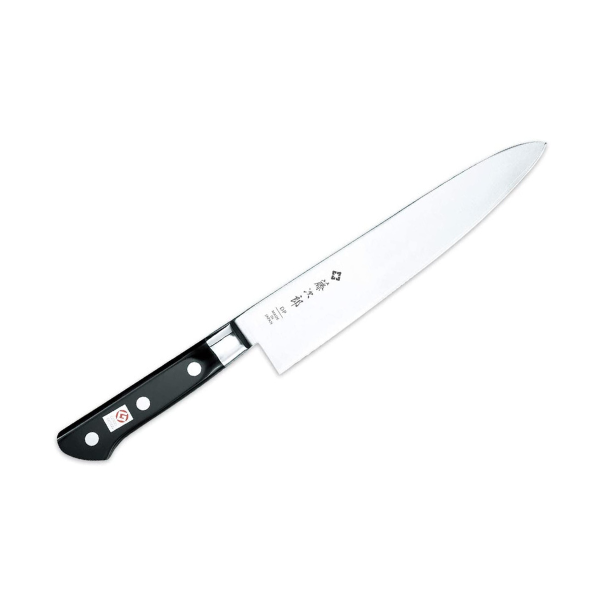
The Gyuto is the Japanese version of the classic western-style chef’s knife. Similar to the western chef’s knife, the Gyuto is a versatile, multi-purpose knife that is suitable for cutting the vast majority of meats, fishes, vegetables, fruits and herbs.

Gyutos are long knives that are commonly tall at the heel with a slight curve from the midsection to the pointed tip of the blade. The relatively flat heel of the blade makes it well-suited for a variety of chopping styles including tap-chopping, push-cutting and pull-cutting, while the slight belly towards the tip of the blade allows for easy rock-cutting. The pointed tip of the blade can also be used for precision cuts.

The Gyuto knife’s double bevel blade is typically thinner, lighter and holds a sharper edge than a Western chef’s knife. For most users, the Gyuto is the best all-purpose knife and the most versatile and useful Japanese knife in the kitchen.

What does Gyuto mean?

Literally translated, ‘Gyu’ means cow (as seen in ‘Wagyu’) and ‘To’ means blade, making the Gyuto a ‘cow blade’.

Like the chef’s knife, the Gyuto was originally designed for slicing and disjointing large cuts of beef, leading to its name. Nowadays, the Gyuto is seen as the equivalent of a western chef’s knife and is primarily used as a versatile all-rounder for cutting meat, fish, vegetables, fruits and herbs.

What is a Gyuto knife best for?

The Gyuto knife is best for chopping, slicing, mincing and dicing boneless meat, fish, vegetables, fruit and herbs. It is a true multi-tasker in the kitchen, and is often recommended as the best all-rounder Japanese knife.

When preparing vegetables, the relatively flat heel of the blade is used to tap-chop or thrust-cut. The slight curve from the middle of the blade leading to its pointed edge is used to rock-chop stiffer produce or herbs, and the pointed tip helps to make fine precision cuts. True to its name of ‘cow blade’, the Gyuto is also excellent at slicing all types of meat. It can be used to pull-cut softer meats or to push-cut more muscular cuts of meat.

The blade of the Gyuto is thinner, lighter and sharper than a western chef’s knife, making it easier to handle and the ideal tool for preparing any kind of dish. However, because the Gyuto is thinner and the types of steel used to make a Gyuto are harder than that of a western chef’s knife, the Gyuto is unsuitable for heavy-duty work. Cutting through bones, or using the blade to smash garlic for example could chip, crack or otherwise damage the blade.

Thrust cutting technique – Japanese Knife Imports

Gyuto knife characteristics

Size

Like the western-style chef’s knife, the Gyuto typically features a long blade and is available in several blade lengths between 180mm to 300mm. For the average user, a blade length of 240mm is best recommended because a longer blade gives additional versatility for cutting larger produce while remaining light and nimble enough in the hand to feel comfortable. If you have a smaller workspace, a blade length of 210mm is another popular choice for home cooks.

Shape

Gyutos are long Japanese chef’s knives that are commonly tall and flat at the heel with a slight curve from the midsection to the pointed tip of the blade. The relatively flat heel of the blade makes it well-suited for a variety of chopping styles such as thrust-cutting, while the slight belly towards the tip of the blade allows for easy rock-cutting. The pointed tip of the blade can also be used for precision cuts and is particularly useful when working in tight spaces.

Edge

Gyuto knives are a popular all-rounder knife with a familiar double bevel edge to the blade, but is much sharper than a standard western chef’s knife. The bevels along the cutting edge are usually sharpened at a more acute angle than the western chef’s knife, giving the Gyuto its signature razor-sharp edge. The types of steel used for making Gyutos also tends to be much harder, which helps the Gyuto to retain its ultra sharp edge for a longer period of time.

Handle

The Gyuto is available with either a western-style handle or a Japanese-style handle (wa-handle). A Gyuto with a Japanese-style handle is called a Wa-Gyuto.

The most common wa-handle shapes are the D-shape, oval, or octagonal. While some prefer the ergonomic grip of a D-shaped or octagonal handle, the choice of the handle comes down to personal preference.

How are Gyuto knives made?

To understand how Gyuto knives are made and to decode the common phrases that are found in knife descriptions, it’s best to look at traditional Japanese knife forging methods and the materials used.

There are two basic categories of Japanese knives – honyaki and kasumi – which are defined by the materials and methods used in their forging.

Honyaki (“true-forged”) knives are manually forged by hand following traditional Japanese blacksmithing techniques, and are created entirely out of one single material: high-carbon steel (hagane). The hagane is typically a type of White Steel (Shirogami) or Blue Steel (Aogami), and this style of knife blade is also called a mono steel blade.

The method of creating a Honyaki knife is similar to how Katanas (Japanese traditional swords) were made in the past. Forging a Gyuto knife is a lengthy and difficult manual process that begins with a single high-carbon steel blank, and involves multiple rounds of heat treatment, steel hammering, kilning, polishing and sharpening. This is done manually in the hands of skilled blacksmiths in Japanese cities famous for their knife production, such as Sakai (in Osaka), Seki (in Gifu), and Echizen (in Fukui).

Because Honyaki knives are forged from high-carbon steel, its blade is extremely hard and can be sharpened to incredibly thin and sharp edges that will remain sharp for a long time. However, they are challenging to resharpen and prone to chipping, cracking, or breaking if used improperly. Due to the small-scale production and the highly-skilled artisan nature of the blacksmiths, Honyaki knives are more expensive, and recommended for experienced and professional chefs who can maintain them.

On the other hand, Kasumi (“mist”) knives are made by joining together a piece of soft iron (jigane) with a piece of high-carbon steel (hagane) to create a laminated blade. After forging, hammering and shaping, the carbon steel (hagane) forms the core and cutting edge, while the soft iron (jigane) clads the body and spine of the blade. The hazy appearance of the soft iron in contrast with the glossy carbon steel gives kasumi its signature ‘mist’ appearance, as referenced by its name. Thanks to the added soft iron, Kasumi blades have reduced brittleness overall, and are cheaper and easier to sharpen than honyaki knives.

In relation to kasumi knives, Hon Kasumi or Hongasumi knives are also commonly found, and refers to a higher grade of kasumi knives. Although hongasumi knives are made in the same way as kasumi knives, they are often made from higher quality materials and involve extra attention and steps in its forging, tempering, polishing and finishing processes.

For more information on how Japanese knives are made and the types of steels used, check out our blog on how Japanese knives are made. (link coming soon)

What are common variants of Gyuto knives?

There are two common variations of the Gyuto knife: the Wa-Gyuto and the Kiritsuke-Gyuto, or K-tip Gyuto for short.

Wa-Gyuto

The Wa-Gyuto is a Gyuto knife with a traditional Japanese handle (Wa-Handle). Wa-handles are usually made from wood, and tend to have an overall lighter feel. The balance point of a Wa-Gyuto knife is further towards the tip, which allows the knife to do most of the cutting work for you. The forward balance of the Wa-Gyuto makes the knife easier to wield, especially when directing the sharp tip of the blade to make precision cuts.

Knife Talk: An Intro To The Wa-Gyuto And How It Differs From Your Typical Gyuto:

Kiritsuke Gyuto – Also called K-tip Gyuto

The Kiritsuke Gyuto is a variant of the Gyuto with an angled ‘reverse tanto’ tip, like those seen on a Kiritsuke knife. The K-tip Gyuto is different in its shape to the typical Gyuto as it has a very flat edge rather than the slight curve at the front of the blade as seen on a regular Gyuto. This makes the K-tip Gyuto less ideal for users who use a rock-chopping method, but better suited for those who use a push-cutting or tap-chopping method.

Kiritsuke Gyuto knives are available in blade lengths ranging from 240mm to 330mm, and the 270mm size is a popular alternative to the Gyuto.

What are popular Gyuto knife brands?

The Gyuto knife originates from Japan, and to this day, traditional blacksmiths in Japan still forge Yanagiba knives manually by hand in famous knife-manufacturing cities such as Sakai (in Osaka), Seki (in Gifu), and Echizen (in Fukui).

However, thanks to the rising popularity of the Gyuto as the Japanese equivalent of a western chef’s knife, both Japanese and Western knife manufacturers now also offer their own versions as well. Some popular Gyuto knife brands include:

  • Mac
  • Masamoto
  • Takamura
  • Tanaka
  • Anryu
  • Masakage
  • Gesshin Uraku
  • Suisin
  • Tojiro
  • Yoshihiro
  • Shun

How to choose a Gyuto knife


If you’re in the market for a Gyuto knife, it can seem difficult to figure out which particular one will be perfect for you, especially if you haven’t had the chance to try out a few models in person to get a feel for what size and style of the Gyuto feels the most balanced and stable in your hand.

You can see our best recommendations here, but here are some factors to first consider that will help you to choose your Gyuto knife:

  • Types of steel
  • Handle styles
  • Ideal size
  • Your budget

Which steel should I choose for my Gyuto knife?

Generally speaking, you have a choice between carbon steel and stainless steel when buying a Gyuto knife. The type of steel you choose will determine the knife’s edge retention, how easy it is to sharpen, level of resistance to corrosion and rusting, and its overall durability. You can first evaluate which of these factors is the most important to you, and narrow it down from there.

Carbon-steel blades are easier to sharpen and maintain their sharp edges for longer, but require more maintenance as it is prone to rust and corrosion. Over time, a dark patina will form on a carbon-steel knife. Popular high-carbon steel options include White Steel (shirogami) and Blue Steel (aogami).

Stainless steel blades are generally less expensive, tougher, less likely to chip and more corrosion-resistant, however are harder to sharpen and tend to dull quicker. Popular stainless steel options include VG-10, SG-2, AUS-10, Gingami #3 and Swedish Stainless Steel.

What size Gyuto should I buy?

We recommend the most popular sizes of 210mm or 240mm as the best size for a Gyuto. To help you decide, here are some questions to think about when selecting the size of your Gyuto knife.

  • How big is your workspace? Is your chopping board or your prep area big enough for the knife?
  • What is the size of the ingredients you commonly use? If you routinely cut large produce such as cabbage, the larger 240mm size will be very helpful. If you’re mostly cutting vegetables, chicken breasts and other similar sized items, a 210mm size will work well.
  • What is your cutting technique? If you use a rock-cut, a larger knife will help you to minimize extreme up-and-down motions with the handle when dealing with larger produce. If you tap-cut, a larger knife will provide a longer cutting edge, helping you to get through the ingredients quicker.

What is the best handle for a Gyuto knife?

The handle of your Gyuto knife will determine where the balance point is in your knife, and how comfortable it feels to use in your hand.

Consider your usual grip on a knife. If you mostly hold the knife by the handle, a shaped or tapered Western-style handle will feel most comfortable and familiar to you. The balance point of a Gyuto with a western handle tends to be near the center or back of the blade.

If you hold the knife using a pinch grip, a Wa-Gyuto with a traditional Japanese-style handle (‘wa-handle’) will feel great in your hand. The most common wa-handle shapes are the D-shape, oval, or octagonal, and while some prefer the ergonomic grip of a D-shaped or octagonal handle, it all comes down to personal preference. The balance point of a Wa-Gyuto knife is further forward, towards the tip.

How do I take care of a Gyuto knife?

When purchasing a Gyuto knife, it’s important to think about how you will care for and maintain your Gyuto knife. Gyuto knives should be sharpened with water whetstones, and always hand washed and dried after use to prevent rusting and corrosion.

There are lots of detailed videos on YouTube that show you step-by-step how to sharpen your Gyuto knife. Otherwise, some Gyuto knife sellers offer a paid sharpening service by trained Japanese knife sharpeners, which can be an easier option.

How much should I spend on a Gyuto knife?

There are countless options for a Gyuto knife, starting with budget-friendly Gyuto knives to traditionally hand-forged honyaki Gyuto knives for over $500. Setting your own spending limit will help narrow down your hunt for the best value Gyuto knife.

If you’re looking for some tried and tested Gyuto knife recommendations, this Tojiro DP Gyutou – 8.2″ (21cm) is the best entry-level choice to test out the sharpness of a Gyuto knife. Tojiro are a highly-regarded Japanese knife manufacturer, and the performance of their knives are known to stand the test of time.

If you’re looking to invest a little more, our favorites include the Yoshihiro VG10 16 Layer Hammered Damascus Gyuto Japanese Chefs Knife (8.25” (210mm)) and the Suisin Inox Western-Style Knife Series, Genuine Sakai-Manufactured, Inox Steel 9.4″ (240mm) Gyuto Knife because both knives are handcrafted by skilled Japanese blacksmiths, and offer easier maintenance and usage with rust-resistant steel and western handles. Yoshihiro and Suisin are consistently recommended for their knives that offer great bang for your buck.

How to choose a Gyuto knife – Japanese Chef’s knife – Wa-gyuto

Frequently asked questions

Should I buy a Gyuto knife?

If you’re interested in the world of Japanese knives, there’s no better place to start than the Gyuto. As the Japanese equivalent of a western chef’s knife, it’s a true all-rounder in the kitchen that will easily glide through your meats, fish, vegetables, fruits and even herbs. It’s a knife that you will use daily, rather than a specialized knife which will sit unused and neglected.

The Gyuto is suitable for various types of cuts, including thrust-cutting push-cutting, pull-cutting, tap-chopping and even rock-chopping, thanks to its mostly flat edge profile and the slight curve towards the pointed tip. This makes it suitable for almost every type of cook, and is the perfect gateway into the world of Japanese knives.

What’s the difference between a Gyuto and a Chef’s knife?

Simply put, the main difference of the Gyuto from a western chef’s knife is that the Gyuto has a thinner, lighter, and sharper blade. The Gyuto is also typically made from much harder steel and holds an edge better than the thicker and heavier western chef’s knife.

How do you sharpen a Gyuto knife?

As a rule, the Gyuto knife should only be sharpened using a whetstone when necessary, and never placed in the dishwasher. Here’s an easy to follow guide on how to sharpen a Gyuto knife:

For more tips, insights and tricks, visit our page on how to sharpen Japanese knives. (link coming soon)

Who makes the best Gyuto knife?

At Japanese Knives Guide, we believe that the best Gyuto knife is one that fits your budget, grip style, expected steel type and your chosen size of the blade. Of course, everybody will have different resources and requirements, so our ‘best’ recommendations are always those which present great value for money.

If you’re new to the world of Japanese knives, our foolproof recommendation is this: before jumping at the first chance to own an expensive, high-end Gyuto knife, why not try your hand at a budget-friendly Gyuto knife to see if it’s the right fit for you?

Traditionally hand-forged and high-carbon steel Gyuto knives can easily cost a fortune, and although beautiful, they require some training to get used to the high-maintenance care routine that’s required to keep them in their pristine original condition. It’s always better to first get a feel for the specific qualities of a specialized knife before committing to invest more. That way, you can spend some time mastering different chopping and handling techniques without the fear of damaging your expensive investment piece.

Amazon is an accessible and reputable retailer with plenty of Gyuto knife options, a transparent customer review section and an incredibly generous returns policy, which makes it the perfect hassle-free and worry-free option for your first Gyuto purchase. There are many specialized smaller retailers out there, but you’ll be hard-pressed to find one that can provide as much peace of mind with the same level of service and returns policy as Amazon.

With that in mind, this Tojiro DP Gyutou – 8.2″ (21cm) is our favorite entry-level choice to test out the sharpness of a Gyuto knife. Tojiro are a highly-regarded Japanese knife manufacturer, and the performance of their knives are known to stand the test of time.

If you’re looking to invest a little more, some great options include the Yoshihiro VG10 16 Layer Hammered Damascus Gyuto Japanese Chefs Knife (8.25” (210mm)) and the Suisin Inox Western-Style Knife Series, Genuine Sakai-Manufactured, Inox Steel 9.4″ (240mm) Gyuto Knife because both knives are handcrafted by skilled Japanese blacksmiths, and offer easier maintenance and usage with rust-resistant steel and western handles. Yoshihiro and Suisin are consistently recommended for their knives that offer great bang for your buck.

Where to buy a Gyuto (Chef’s) knife

Amazon is an accessible and reputable retailer with many Gyuto knives on offer, plus a very generous returns policy for extra peace of mind.

If you’re looking for some tried and tested Gyuto knife recommendations, this Tojiro DP Gyutou – 8.2″ (21cm) is the best entry-level choice to test out the sharpness of a Gyuto knife. Tojiro are a highly-regarded Japanese knife manufacturer, and the performance of their knives are known to stand the test of time.

For beginner Japanese knife enthusiasts with a little more budget, we highly recommend the hand-crafted Yoshihiro VG10 16 Layer Hammered Damascus Gyuto Japanese Chefs Knife (8.25” (210mm)) and the Suisin Inox Western-Style Knife Series, Genuine Sakai-Manufactured, Inox Steel 9.4″ (240mm) Gyuto Knife. Both knives are handcrafted by skilled Japanese blacksmiths, and offer easier maintenance and usage with rust-resistant steel and western handles. Yoshihiro and Suisin are famous for their attention to detail, extremely sharp edges and durable, high-quality knives.